
















Top Toledo Attractions
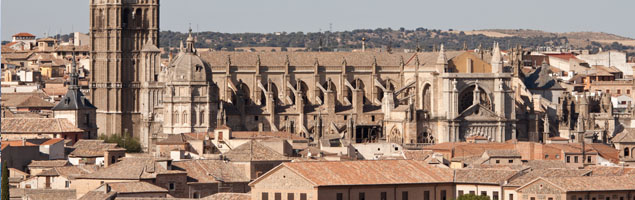
- Catedral / Cathedral
- Alcázar / Fortress
- Sinagoga de Santa María la Blanca / Santa María la Blanca Synagogue
- Sinagoga del Tránsito / El Tránsito Synagogue
- Mezquita de Cristo de la Luz / Cristo de la Luz Mosque
- Iglesia de San Sebastián / San Sebastián Church
- Monasterio de San Juan de los Reyes / San Juan de Reyes Monastery
- Casa-Museo de El Greco / El Greco House - Museum
- Puerta de Sol / Sol Gateway
- Museo de Santa Cruz / Santa Cruz Museum
- Plaza del Zocodover / Zocodover Square
Top Festivals
Semana Santa / Holy Week
March or April
Corpus Christi / Corpus Christi
May or June
Fiesta de la Asunción / Feast of the Assumption
August 15
Food & Drink
Toledo's traditional cuisine dates back centuries and is based on simple peasant fare. Wild game plays a big role in regional dishes, especially partridge which is prepared in numerous different ways.
- Perdiz estofada / Stewed partridge
- Sopa de ajo / Garlic soup
- Cocido de tres vuelcos / Stew with chickpeas, meat, vegetables, etc.
- Caldereta / Lamb with onions, garlic, tomatoes, peppers & white wine
- Carcamusas / Stewing steak or pork with peas and tomatoes
- Migas / Fried sausages, garlic and bacon with bread crumbs
- Crema de cangrejos / Cream of crab
- Truchas a la toledana / Toledo-style trout
- Arroz a la toledana / Rice casserole with chicken, eel, squid and wild mushrooms
- Venado con setas o con peras / Venison with wild mushrooms or pears
- Cochifrito / Lamb or young goat, stewed and then fried in oil, garlic, vinegar and spices
- Mazapán / Marzipan
Weather
On the whole, weather in Toledo is dry and sunny, though the climate is characterized by extremes with summers that are dry and scorching hot and winters that can be quite chilly. Spring and fall boast wonderfully comfortable temperatures, through they are also the seasons in which the bulk of annual rainfall is concentrated.
Getting There
By plane
The closest and most convenient airport for a visit to Toledo is Madrid's international airport. Madrid is located just 70 kilometers from Toledo and the two are very well connected by bus and train routes (see below).
By train
If you're traveling by train to Toledo, by default you will have to pass through Madrid. The train stations of Madrid and Toledo are now connected by the high speed train, the AVE, which is just a 30 minute ride for around 15 euros. Toledo's lovely new-Gothic train station, built in the early 20th century, is located on Paseo de la Rosa.
By bus
Like with the train, the easiest place from which to access Toledo by bus is Madrid. Buses travel between the two cities every 30 minutes, based out of the Méndez Álvaro station in Madrid and the Bus Station in Toledo, located on Avenida Castilla-La Mancha. Aside from Madrid, there are buses that leave Toledo for numerous towns throughout the region of Castilla - La Mancha; for cities outside of the region your best bet is to pass through Madrid first.
Getting Around
Toledo's historical center, where you're likely to spend the entire time, is compact and best explored on foot. Plus, wandering the medieval winding streets is a delight that transports you back to another time. There is a city bus network in place that covers the new and old sections of Toledo.
Fast Facts
| Population | Approx. 81,000 (city proper) |
| Autonomous Community | Castilla - La Mancha |
| People | Toledanos |
| Languages | Spanish |
| Location | Center of Spain, 70 kilometers south of Madrid |
| Tourist Office | Puerta de Bisagra Tel: (+34) 925 220 843 |