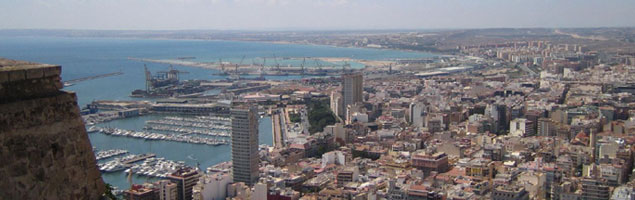
Alicante Travel Guide
Alicante Fast Facts
| Population | Approximately 325,000 |
| Autonomous Community | La Comunidad de Valencia |
| People | Alicantinos |
| Languages | Spanish and “Valenciano” (similar to Catalán) |
| Geography | Set on the eastern section of Spain’s Mediterranean coast, the “Costa Blanca.” Bordered inland by mountains. |
| Climate | Typically Mediterranean – hot summers and mild winters. Little rainfall. |
| Average Yearly Temperature | 18ºC (65º F) |
| Local fare | Rice dishes, seafood, fresh fruit and vegetables, nougat, horchata (iced almond milk) |
| Tourist Office | Rambla de Méndez Núñez, 23 Tel (+34) 96 520 00 00 |
| Did you know? | The Romans named Alicante “Lucentum,” which means “City of Light” |
Alicante City Highlights
Explanada de España & Playa Postiguet
Alicantino writer Juan Gil-Albert wrote: “Estar en Alicante es estar en la Explanada” (To be in Alicante is to be on the Explanda). A grand total of 400 palm trees line this maritime boardwalk, providing shade for numerous outdoor cafes. We recommend the music pavilion for free outdoor concerts, and the colorful hippy market selling every class of odds and ends. Adjacent Postiguet Beach is surprisingly clean considering its position right in the city center. Best of all, you’ll study Spanish with Enforex right in this area!
El Barrio
The old part of town, simply called “the neighborhood” in Spanish, holds beautiful historic churches and a unique 12th century cathedral. More than the sights, this area is famous for its thumping nightlife. Locals and tourist mix to bar-hop from one great spot to the next in a friendly, open environment.
Castillo de Santa Bárbara
This hilltop castle, Alicante’s main sightseeing stop, is the best place to soak in city vistas.
Nightlife
Outside of El Barrio, you can party ‘til dawn around el Puerto (the Port) and Isla Marina, home to Alicante’s Regata Club.

Visit Alicante During...
APRIL: Fiesta de Moros y Cristianos
The Moors and Christians Festival celebrates Saint George, Alicante’s patron saint. Legend has it he appeared on a white horse in the Middle Ages to help Christians take back the region’s Muslim-controlled territories. Locals put on an elaborate reenactment of the battle, replete with costumes, explosions and more. It’s a festive and culturally fascinating time to study Spanish in Alicante.
JUNE: Las Hogueras
Fireworks paint the sky and papier-mâché constructions go up in flames during this dramatic festival, the most important of the year. As with every Spanish fiesta, general fun and debauchery ensue throughout the month.
Getting to Alicante
By Air
Alicante-El Atlet International Airport is 12km (7.5 miles) west of the city center. You can fly direct from most major European and Spanish cities. Travelers from outside Europe, however, will have to connect through another airport.
By Train
Located in the city center on Avenida de Salamanca. National trajectories to all major Spanish cities. (3.5 hours to Madrid, 5 hours to Barcelona)
By Bus
Estación Central de Autobuses, Calle Portugal, 17. Local, national and international services.


