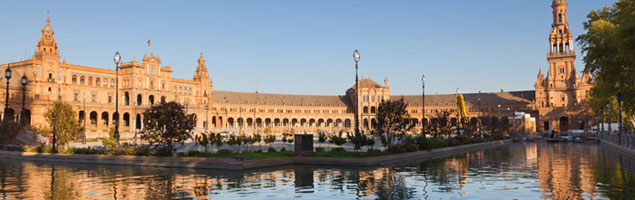
Sevilla Travel Guide
Sevilla Fast Facts
| Population | Approx. 705,000 |
| Autonomous Community | Andalusia/ Andalucía |
| People | Sevillanos |
| Geography | Southwest Spain |
| Climate | Mild winters, dry all year round, long summers from May to October with scorching weather in July and August. |
| Average Yearly Temperature | 25ºC (77ºF) |
| Local fare | Tapas: snails, spinach with chickpeas, fried fish, pincho moruno (meat skewer), cured ham, egg scrambles, gazpacho, stuffed artichokes, wine and sherry. |
| Tourist Office | Calle de Arjona 28 Tel (+34) 954 221 714 |
| Did you know? | Sevilla's cathedral - the world's 3rd largest - holds a monument and tomb to Christopher Columbus. But is he really buried there? The jury's still out. Between Sevilla, Hispañola or Havana... it's a veritable unsolved mystery. |
Sevilla City Highlights

Barrio Santa Cruz
It doesn't get more romantic than the Barrio Santa Cruz: white-washed facades, iron balconies draped with flowers, the most narrow, winding streets imaginable and abundant charming patios characterize Sevilla's historic Jewish quarter. You can soak up rays on any number of typical terrace cafes, or head up the stairs of Enforex Sevilla to our pleasant roof deck and socialize with students from all over the world. You'll study Spanish in Sevilla right in the heart of this incredible area!
The Cathedral & Alcazar
Sevilla's 2 central monuments, the Cathedral and Alcazar, embody the city's fascinating cross-cultural history. For more than 500 years, Sevilla was the capital of Muslim Spain, or "Al-Andalus." Then, after the Catholic reconquista in 1258, the city became a favorite royal stomping grounds and, later, the recepticle of New World riches for a vast Catholic Empire.
Both the Cathedral and Alcazar represent these deeply seeded cross-cultural influences. The Cathedral was built on top of an Almohad Mosque, however the mosque's accompanying minaret, the "Giralda," remains. At once you find one of the world's oldest minarets and largest churches side by side. The secular Alcazar, first constructed as a Moorish palace in the 7th century, developed into a revamped royal residence in the 15th century. This building impresses as a prime example of mudéjar architecture, a style crafted by Muslims artists working in Christian lands.
Flamenco & Folklore
Sevilla, the heart of folkoric Spain, is the best place to experience a bullfight or flamenco show. Its one of the few places where you'll actually find women decked out in polka-dot dresses on special occassions, or spontaneous flamence wailing on the street. If you're interested in acquiring a profound understanding of Andalusian culture, check out our learn Spanish + flamenco course in Seville!
Visit Sevilla During...
SPRING: Semana Santa & La Feria de Abril
Spring is a wonderful time of year to study Spanish in Sevilla for a number of reasons. For one, the weather starts warming up but the heat is not unbearable. For another, between Easter week and the end of March the city bursts at the seams as it welcomes thousands of visitors for the festival season. First comes Semana Santa, with the world's most extravagant processions and passion scenes. Then, to close April out you have the Feria de Abril, a traditional flamenco celebration with food, drink and dancing set up in temporary fairgrounds.
Getting to Sevilla
By Air
At the moment, only European and national carriers fly to Sevilla's airport, located 12km (7.5 miles) northeast of the city. The "Amarillos airport bus" runs every 30 minutes by the train station to the cathedral (lesson than 3€). A taxi to the center costs about 15€.
By Train
The main train station, Santa Justa, is a bit of a hike outside the center on Avda. Kansas City. Local bus #32 runs to the center from here. Spain's high-speed train, the AVE, gets you to Madrid in just 2.5 hours, stopping through Cordoba. Santa Justa is a main RENFE hub (Spain's national rail company) with direct routes all throughout the country.
By Bus
Buses serving Andalusia mainly run through Estación Prado de San Sebastián, on c/ Manuel Vázquez Sagastizabal. National and international routes arrive and depart at the Plaza de Armas station on Avenida Cristo de la Expiración.


