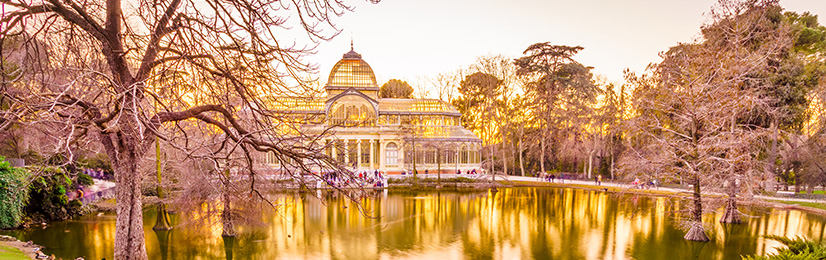
Madrid Travel Guide

Madrid Travel Guide

Madrid Fast Facts

Population 4 million (approx)
Autonomous Community La Comunidad de Madrid
People Madrileños
Geography Right in the center of the Iberian Peninsula.
Climate Autumn (September and October) is the best time of year to be in Madrid, with sunny days and mild temperatures. Winters are cold, though temperatures rarely dip deep below freezing. Spring tends to be beautiful with variable rains while summer, starting in June, is a veritable scorcher.
Average Yearly Temperature Min. 7.6ºC (45ºF), Max. 20ºC (68ºF)
Local fare Hearty meat stews ("caldo madrileño"), potato omlette (tortilla española), ham and cheese croquettes, cured ham, manchego cheese, callos (tripe).
Tourist Office Plaza Mayor 3
Tel (+34) 915 881 636
Did you know?
Madrid was named capital in 1561 by Hapsburg Phillip II. Before that, it was an unimportant "villa," not even a close competitor to nearby Toledo, the medieval capital.

Madrid City Highlights

El Paseo del Arte & El Retiro
Madrid's "big three" museums- the Prado, the Reina Sofia and the Thyssen - all lie on the same boulevard known as "Paseo del Arte." Together they hold some of El Greco, Goya, Velazquez, Picasso, Dalí and Miró's greatest works, not to mention a slew of international masters. Ascend the hill just behind the Prado Museum to discover Madrid's main park, "El Retiro."

Sol & Los Austrias
Puerta del Sol, Madrid's ground zero, is the city's bustling meeting place par excellence. Radiating off of Sol you can wander through Hapsburg Madrid, "Los Austrias," which encompasses the Royal Palace, Plaza Mayor, old churches and beautiful squares with outdoor cafes and tapas bars.

El Rastro
On Sundays and holidays, the area between Plaza Tirso de Molina and Glorieta de Embajadores holds the country's most famous open-air market. Different streets hold different treasures, knick-knacks and junk, from antique furniture to cheesy t-shirts. It's always packed, and afterwards the area fills with madrileños enjoying their last beers and tapas before returning to work on Monday. If you decide to study Spanish in Madrid, go to the Rastro at least once... you won't be disappointed!

Nightlife!!!
Madrid is capital in many respects, but above all for its nightlife. Nocturnal trysts roar throughout the city on weekends, but you can find a hopping party on any weeknight as well. A true night of going out ("salir") lasts until 6am at the earliest. Even though New York holds the title, we'd wager that Madrid is truly the city that never sleeps.

Visit Madrid During...

DECEMBER: Christmas & New Year's Eve
Madrid lights up during Christmas, its avenues and boulevards lined by brilliant Christmas fixtures and decorations. Shoppers pack the area around Puerta del Sol, and the season culminates here with debaucherous New Year's celebrations. The whole country counts down to Sol's clocktower, following the tradition of eating a grape at each toll. If you want to experience one of the world's craziest New Year's parties, this is the perfect time to study Spanish in Madrid.

MAY: Dos de Mayo & San Isidro
Madrid welcomes the spring with a variety of celebrations. First, Dos de Mayo celebrates the May 2nd, 1808 madrileño rebellion against Napolean's occupation.. The fiestas de San Isidro on May 15th, Madrid's patron saint, include week-long bullfights and typical music and dress, plus outdoor partying that lasts til dawn.

AUGUST: Neighborhood Fiestas
As the summer begins to cool off (if only a bit), a variety of barrios claim their saint's weekend to celebrate local fiestas. Bars serve drinks on the streets, mostly in old parts of the city like Lavapiés and La Latina.

Getting to Madrid

By Air
A new terminal was just added to Madrid Barajas International Airport, making it among the top 5 largest and most important in Europe. National and international carriers from all continents fly here direct. It's 16 km (10 miles) east of the center, with bus and metro service at Terminals 1, 2 & 3. If you fly into Terminal 4, the new addition, you'll have to hop on an inter-terminal bus or local EMT bus # 201 to the Barajas metro stop. A taxi to the center will cost about 25€.

By Train
Estación de Atocha handles most RENFE trains (Spain's national rail service). There are routes all over Spain and even to Portugal and France. It's easily accesible by metro, and right by the Reina Sofia Museum.

By Bus
Madrid has a couple of bus stations, but the largest is Estación Sur at metro stop Méndez Álvaro. Routes, prices and locations vary by company. You can call +34 91 435 22 66 for general information.