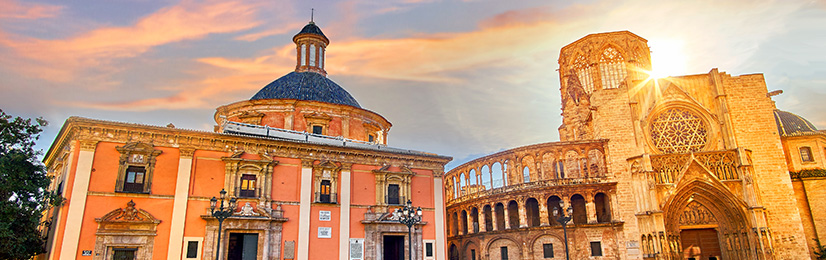
Valencia Travel Guide
Valencia Fast Facts
| Population | Approx. 795,000 (city proper) |
| Autonomous Community | La Comunidad de Valencia |
| People | Valencianos |
| Languages | Spanish and Valenciano/ Valencià |
| Geography | On Spain's mideastern Mediterranean coast. |
| Climate | Typically Mediterranean - mild winters and hot, dry summers |
| Average Yearly Temperature | 21.5ºC (70ºF) |
| Local fare | Valencia claims to be the birthplace of paella. The traditional regional style is saffron rice with chicken, rabbit, beans, snails and artichockes. There are more than 200 other rice dice varieties combining seafood, shellfish, game, vegetables and more. |
| Tourist Office | Calle de la Paz, 48 Tel (+34) 963 986 422 |
| Did you know? | Valencia is famous for its "horchata" - a frozen drink made of tiger nuts ("chufas"). It's a great refreshment on a hot day, and there are even specialized locales called "horchaterías." |
Valencia City Highlights
The City of Arts & Sciences
Santiago Calatrava, among the world's most sought-after architects, constructed this project for his hometown. It's a spectacular, hemispheric complex with a glimmering reflection pool. Don't miss the chance to see an outdoor concert here at night while the whole "city" is perfectly lit. There are 5 different sections: an arts pavillion, Europe's largest aquarium, an interactive science center, a planearium/ IMAX dome and a botanical garden.
Barrio del Carmen
This neighborhood, the city's historic quarter, is made up of winding, maze-like streets perfect for exploring and strolling. Around here you'll find the sights typical to any ancient Spanish city: the cathedral, city hall, and numerous plazas now set up with outdoor cafes.
The Beach
One of the best parts of studying Spanish in Valencia is you're right on the beach! The most lively city beaches, Las Arenas and Malvarrosa, are connected by a busy boardwalk full of restaurants and cafes. If you prefer a more secluded experience, you can also hop on a bus to arrive at any number of local shores.

Visit Valencia During...
MARCH: Las Fallas
Las Fallas is an incredible fiesta that welcomes spring with a bang. Residents essentially plan all year round to commission "fallas," pieces of art constructed around a wooden skeleton and covered in papier-mâché to create satirical human and animal figures, often reaching more than 20 meters (65 ft) high!
At the festival's pinnacle, the fallas are paraded around town and fireworks, firecrackers and light shows abound. On the last night, the fallas are burned and the city seems to burst into flames. General debauchery ensues on the streets of Valencia and it might just be Spain's craziest party (and that's saying a lot).
JULY: Feria de Julio
This festival consists of even more fireworks and outdoor concerts. The city lights up in its typical fashion with happy throngs of partiers in the streets.
Getting to Valencia
By Air
The Valencia airport serves national and European carriers. It's located 8km (5 miles) from the center. There are suburban trains, "Cercanías," that will zip you over to the city's train station.
By Train
The Estació del Nord is located on Calle Xàtiva, 24. Direct RENFE trains - Spain's national rail service - run through here from the major Spanish cities and nearby towns.
By Bus
Valencia's bus station is Estación Terminal d'Autobuses, on Avenida Menéndez Pidal, 13. A variety of routes throughout Spain are offered by different bus companies.


