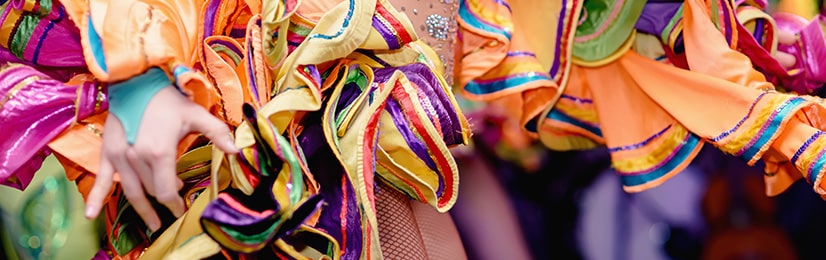


Enforex has schools in the two Spanish cities famous for their annual carnival festivities: Puerto de la Cruz (Tenerife, Canary Islands) and Cádiz. Plus, we keep our schools open all year round so that our students can not only learn Spanish, but they can do so without missing out on characteristic festivals like carnival! Learn more about our year-round Spanish courses in these top carnival destinations:
While there's nothing quite like experiencing the parades, the music and the costumes of a Spanish carnival for yourself, below you can read all about the festival's interesting history and extravagant traditions.
When and Where is Spanish Carnival?
Closely linked to the religious observance of privations prior to the start of Easter, Spanish carnival, with all its debauchery and excesses, usually kicks into high gear sometime in February, the week immediately before the beginning of the 40 days of Lent. Like all celebrations connected to Easter, the dates vary from year to year, although you can be fairly sure that carnival will take place at some point during February or early March. Given the enormous influence of the Catholic church in Spain, the celebration of carnival, ultimately an important part of the religious calendar, is widespread throughout the country. Nevertheless, the arrangements found in Cádiz and Tenerife are no doubt in a class of their own.
Carnival Traditions
Originally conceived as the final day of permissiveness before the start of the long period of penance and privations that lead up to the commemoration of the death of Christ in the form of the Holy Week and, specifically, Easter, carnival soon evolved from a feast oriented towards the consumption of "forbidden" goods (such as meat and sweets) to a full fledged celebration of all things carnal (i.e., the realm of this, rather than the next, world). Ultimately a celebration of life itself, people have long dressed up for carnival, encouraging the free enjoyment of the occasion in the anonymity of a disguise.
Tenerife Carnival
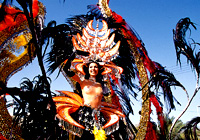
Celebrated in the city of Santa Cruz, in the Tenerife carnival bears a strong resemblance to the one in Brazil, featuring parades with floats, bands performing songs, Brazilian-style ensembles, and thousands upon thousands of people decked out in fancy dress. Street musicians constantly fill the streets, various types of music electrify the air, and the colors and costumes simply delight the view. Festive parades snake through the city, boasting energetic music groups and vibrantly costumed performers. One of the most celebrated traditions is the selection of each year's Tenerife carnival Queen from the parade's most beautiful girls – the elaborate costumes that these girls don take months to create and often weigh more than 100 kilograms (220 pounds)!
Cádiz Carnival
From "Quasimodo Sunday" until "Piñata Sunday", Cádiz carnival dominates the town and injects an explosive dose of color, music, and culture to the placid routine of a small provincial city. The normally laid-back atmosphere is immediately transformed into one huge street party, whose pinnacle is an enormous competition in which street musicians, choirs, quartets, troupes and chirigotas seek to create the most visually and musically original stage performances.
After the competition, both winners and losers take the Cádiz carnival to the streets, joining in the party, and moving through the Old Quarter singing songs, often with risqué, erotic, or satirical themes. If you're heading south for the festivities, a costume is a must as you'll stick out if you go wearing simple jeans and a t-shirt. Spaniards flock to Cádiz in groups from all over, wearing themed costumes that often poke fun at institutions, politics, celebrities, and current events. Nowhere else can you see herds of nuns partying in the streets with "bird flu" chickens.
History of Carnival
These crazy fiestas have certainly evolved quite a bit when you consider how they started. Catholics in Italy began a tradition of holding a costume festival just before the commencement of Lent. Since Catholics aren't supposed to eat meat during those 40 days and 40 nights prior to Easter, they called this festival "carnevale," which roughly means "to put away the meat." The infamous Fat Tuesday began because Catholics had to use up all of the meat and butter before the following day, Ash Wednesday, which by its very name seemed to have often resulted in quite the day of consumption.
In Tenerife, where the celebrations resemble those of Brazil, the huge elaborate costumes and massive use of brilliantly-colored feathers has its origins in African culture. It's no surprise, as the Canary Islands are actually closer to Africa than to Spain.