











Blog

Famous Monuments and Symbols of Spain You Should Know

an aerial view of a park with a fountain

In this article you can discover Spain through its monuments, landmarks and cultural symbols.

Spain is a country full of history, art, legends, and iconic landmarks. Most visitors immediately think of famous places such as the Alhambra, the Sagrada Familia, the Cathedral of Burgos, or the Roman Aqueduct of Segovia. But Spain’s heritage goes far beyond its best-known attractions. Across the country, travelers can discover prehistoric sites, hidden monuments, symbolic statues, traditional festivals, and places that have become part of Spain’s cultural identity.

For students who want to learn Spanish in Spain, exploring these places is also a great way to understand the country’s history and culture more deeply. From Madrid and Salamanca to Seville, Granada, Tenerife, and Galicia, Spain offers countless opportunities to combine language learning with unforgettable cultural experiences.

Spain’s Most Symbolic Monuments and Heritage Sites

Spain is home to an extraordinary variety of World Heritage Sites, historic cities, and monuments of global importance. Some stand out not only for their beauty, but also for their role in shaping Spain’s cultural identity.

The Alhambra in Granada

The Alhambra, located in Granada, is one of the most impressive historic sites in Spain. This palace and fortress complex is admired for its Islamic architecture, gardens, courtyards, and hilltop setting overlooking the city. Few places in Spain rival its artistic beauty, and it has become one of the country’s most admired landmarks.

The Historic City of Toledo

Toledo is one of Spain’s most fascinating historic cities. Its narrow streets, medieval architecture, and layered Christian, Jewish, and Muslim heritage make it feel like an open-air museum. Walking through Toledo is like stepping back into the Middle Ages, which is why it remains one of the country’s most captivating heritage destinations.

The Caves of Altamira

The Caves of Altamira, in Cantabria, preserve some of the oldest known examples of prehistoric cave art in the world. These paintings, created thousands of years ago, are an extraordinary window into early human history and one of Spain’s most important archaeological treasures.

Teide National Park

Not all of Spain’s heritage is architectural. Teide National Park, in Tenerife, is one of the country’s most important natural landmarks. Dominated by Mount Teide, the highest peak in Spain, the park combines volcanic landscapes, cultural significance, and spectacular views. It is one of the most visited natural sites in the country and a symbol of the Canary Islands.

The Oldest Monuments in Spain

Spain’s history stretches back far beyond Roman cities and medieval cathedrals. Some of the country’s oldest sites reveal prehistoric cultures, ancient rituals, and civilizations that existed long before modern Spain took shape.

Atapuerca

The Atapuerca archaeological site, near Burgos, is one of the most important prehistoric discoveries in Europe. Human remains found here are believed to be between 800,000 and 1.2 million years old, making the site essential for understanding early human history on the continent.

Naveta d’Es Tudons

Located in Menorca, the Naveta d’Es Tudons is one of the oldest buildings in Europe. Built around 1000 BCE, this funerary monument is one of the most famous examples of Talayotic culture in the Balearic Islands.

Cancho Roano

In Zalamea de la Serena, in Extremadura, Cancho Roano is one of the best-preserved archaeological remains linked to the ancient Tartessian civilization. The site offers a fascinating glimpse into one of the most mysterious cultures of the Iberian Peninsula.

Numantia

Near Soria, the remains of Numantia recall one of the most powerful stories of resistance in Spanish history. This Celtiberian city became famous for its defiance against Roman siege, and its legacy still occupies an important place in Spain’s historical imagination.

Castro de Santa Tecla

In Galicia, the Castro de Santa Tecla is one of the best-preserved examples of a fortified Celtic settlement in Spain. Its location, archaeological remains, and links to Galicia’s ancient heritage make it one of the most interesting historic sites in the northwest of the country.

Unknown Monuments in Spain Worth Visiting

Beyond the country’s most famous attractions, Spain is full of lesser-known monuments that are equally rewarding for curious travelers.

Jameos del Agua, Lanzarote

Jameos del Agua is one of Lanzarote’s most unique attractions. This cave complex, partly redesigned by César Manrique, combines volcanic nature, artistic intervention, and striking architecture in a way that is unmistakably Canarian.

Zamora Cathedral

The Cathedral of Zamora is a remarkable Romanesque monument in Castile and León. It is especially admired for its dome, which many associate with Byzantine or oriental influences.

Alcántara Bridge

The Roman bridge of Alcántara, in Cáceres, is one of the great engineering achievements of ancient Spain. Over the centuries, it has survived wars, destruction, and reconstruction, becoming a symbol of endurance and historical continuity.

Santa María del Naranco

Located near Oviedo, Santa María del Naranco is one of the finest examples of Asturian pre-Romanesque art. Built in the 9th century, it has long fascinated historians because of its unusual form and the debate around its original purpose.

Palacio del Infantado

The Palacio del Infantado, in Guadalajara, is one of the great examples of late Gothic architecture in Spain. Its façade and historical significance make it one of Castile’s most striking palaces.

Castro de Baroña

In Galicia, the Castro de Baroña stands in an extraordinary coastal setting. The remains of this ancient settlement, located right next to the Atlantic Ocean, give it a dramatic character unlike many other archaeological sites in Spain.

Palacio de la Aljafería

In Zaragoza, the Palacio de la Aljafería is one of the most important surviving palaces from the period of the Taifa kingdoms. Its Islamic origins and later Christian use reflect the cultural layers that define much of Spanish history.

Famous Spanish Symbols: From Madrid’s Bear to the Windmills of La Mancha

Spain is not only defined by monuments and historic buildings. Some places and images have become lasting cultural symbols, instantly associated with the country’s identity.

El Oso y el Madroño in Madrid

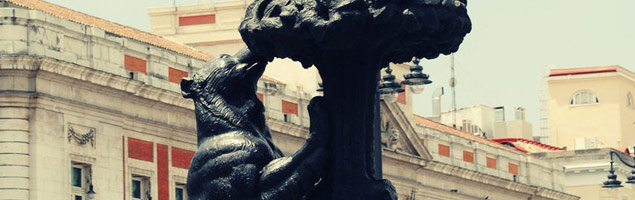
One of Madrid’s best-known symbols is El Oso y el Madroño, the statue of the bear and the strawberry tree in Puerta del Sol. It is one of the capital’s most photographed landmarks and an important symbol of Madrid itself.

According to one popular explanation, the bear refers to the animals that once inhabited the forests surrounding the area, while the tree represents the local vegetation. Whatever the exact origin, the statue has become one of the most recognizable symbols of the city.

The Windmills of La Mancha

The windmills of La Mancha are another powerful symbol of Spain, above all because of their connection to , Miguel de Cervantes’ immortal novel. In one of the book’s most famous scenes, Don Quijote mistakes the windmills for giants, creating one of the best-known episodes in Spanish literature.

Because of this literary association, the windmills have become much more than rural structures: they are part of Spain’s cultural imagination and one of the country’s most iconic images.

Plaza de España in Seville

The Plaza de España in Seville is one of the most beautiful urban landmarks in Spain. Located in María Luisa Park, it was built for the Ibero-American Exposition of 1929 and designed by architect Aníbal González.

Its semi-circular shape, canal, bridges, towers, ceramic benches, and grand scale make it one of Seville’s most spectacular places to visit. The plaza is often described as one of the city’s most beautiful sights and has also appeared in several international films, adding to its fame.

Today, it remains a perfect place for a walk, a boat ride, or simply enjoying the architecture and atmosphere of one of Spain’s most elegant squares.

Salamanca and the Festival of Santa María de la Vega

Spain’s heritage is not only preserved in monuments, but also in the traditions and festivals that keep local history alive. In Salamanca, one example is the Festival of Santa María de la Vega, celebrated every September in honor of the city’s patron saint.

According to local tradition, the Virgin of the Vega protected Salamanca from destruction during the War of the Spanish Succession. In remembrance of this, the city celebrates with cultural events, performances, street activities, food stalls, and heritage-related festivities.

For visitors and students, the festival is a great way to experience Salamanca’s atmosphere, gastronomy, and traditions while discovering one of Spain’s most beautiful historic cities.

Why These Places Matter

Together, these landmarks show the incredible diversity of Spain’s heritage. Some are world famous, others remain hidden gems, but all of them help explain the country’s identity. They tell stories of prehistoric peoples, Celtic settlements, Roman engineering, Islamic palaces, medieval cities, literary myths, and local traditions that are still alive today.

For anyone studying Spanish in Spain, visiting these monuments and symbols offers much more than sightseeing. It is a way to understand the country’s history, regional diversity, and cultural memory firsthand.

Explore Spain Beyond the Typical Highlights

Spain’s best-known monuments deserve their reputation, but some of its most memorable places are the ones travelers discover beyond the classic itineraries. From Madrid’s famous bear statue and the windmills of La Mancha to Atapuerca, the Plaza de España in Seville, and the lesser-known monuments scattered across the country, Spain is filled with stories waiting to be explored.

If you want to combine travel, history, and language learning, these monuments and symbols are some of the best places to start.